A $700 Billion Industry With a Transparency Crisis
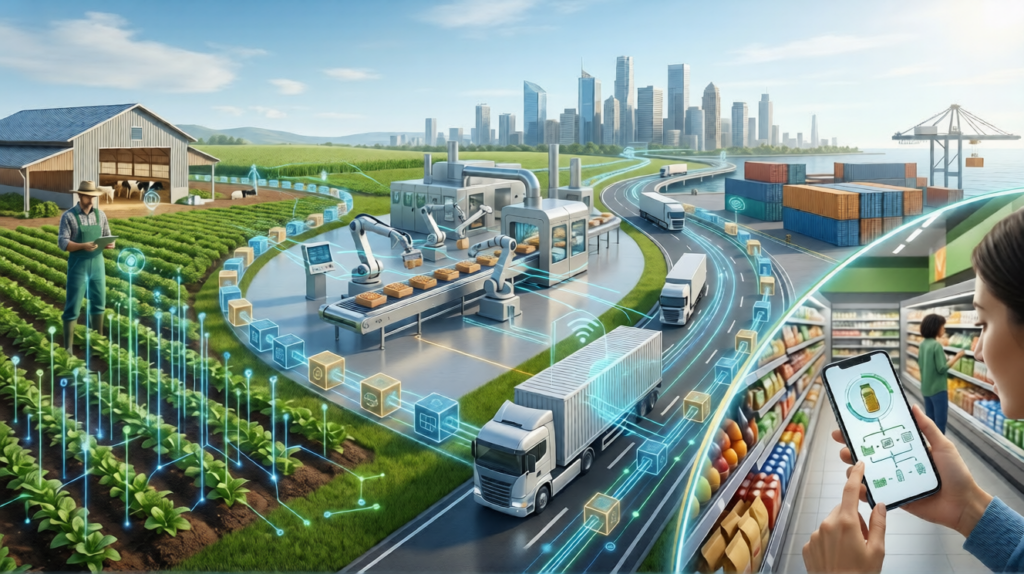
From hot dogs and lunchmeats to bacon, sausages, and corn dogs, the processed food supply chain spans farms, slaughterhouses, processing plants, cold-storage warehouses, and thousands of retail locations — often crossing multiple state and national borders.
Yet each node in the supply chain operates in its own data silo with its own record-keeping system, and little to no real-time interoperability with the next link in the chain.
Unsafe food causes approximately 600 million cases of foodborne illness and 420,000 deaths every year globally — a public health crisis that better supply-chain transparency could significantly reduce.
The question is not whether the food industry needs better data infrastructure — it clearly does. The question is what technology can deliver it at enterprise scale without forcing manufacturers to rebuild from scratch. The answer is blockchain, and platforms like Flexblok.io are making that transition faster and more affordable than ever.
The Core Challenges Facing Food Manufacturers Today
Processed food manufacturers face four compounding, interconnected challenges that no single legacy technology has resolved simultaneously.
1 Food Safety Recalls and the Cost of Contamination
When a contamination event strikes — listeria, E. coli, salmonella — manufacturers must trace affected batches through the entire supply chain, often within hours. Current systems built on paper records, disconnected ERP databases, and manual audit processes make precision tracing nearly impossible. Companies typically recall far more product than necessary, absorbing enormous losses.
2 Supply Chain Opacity Across Multiple Tiers
A typical processed food manufacturer sources ingredients from dozens or hundreds of suppliers, each running its own data systems. There is no shared real-time ledger providing visibility into where an animal was raised, how it was handled post-slaughter, cold-chain conditions, or distribution routing. This opacity is simultaneously a food safety risk, a compliance risk, a brand risk, and a growing commercial barrier as major retailers mandate transparency from vendors.
3 Regulatory Compliance Complexity
Food manufacturers operate under USDA and FSIS oversight, HACCP protocols, FSMA record-keeping requirements, and — for exporters — country-specific certification frameworks across Canada, Japan, South Korea, Hong Kong, and Mexico. A 2025 Springer study found that blockchain adoption can reduce compliance processing times by 40–70 percent compared to manual systems.
4 Eroding Consumer Trust and the Transparency Premium
Modern consumers demand verifiable proof of food origin. The same Springer research documents that blockchain-enabled supply chains achieve an 80 percent reduction in fraud incidents, a 12.5 percent rise in consumer satisfaction, and a 50 percent drop in complaints — translating directly into stronger retail relationships and defensible pricing power.
What Is Blockchain and Why Is It Built for the Food Industry?
Blockchain is a distributed ledger that records data in cryptographically linked, immutable blocks. Once a record is written, it cannot be altered without leaving a detectable trace. Every transaction is timestamped, digitally signed, and simultaneously accessible to all authorised participants — creating a single tamper-proof source of truth across the supply chain.
| Property | What it delivers | Legacy gap |
|---|---|---|
| Immutability | Temperature logs, batch numbers, certifications cannot be altered after the fact — eliminating fraud. | Editable ERP records |
| Transparency | All authorised parties share real-time access to the same verified dataset. | Siloed per-department data |
| Traceability | Any product traced to origin in seconds. Walmart-IBM pilot: 7 days → 2.2 seconds. | Days of manual investigation |
| Smart Contracts | Compliance checks, quality alerts, and recall triggers execute automatically on predefined conditions. | Manual human review |
Walmart's blockchain pilot with IBM using Hyperledger Fabric reduced mango provenance tracing from seven days to 2.2 seconds — a 99.9% improvement that set a new industry benchmark.
Flexblok.io: Enterprise Blockchain Without the Complexity
The historic barrier to blockchain adoption in food manufacturing has been cost and technical complexity. Building custom blockchain infrastructure requires a dedicated engineering team, months of development, and significant ongoing maintenance — prohibitive for most food manufacturers.
Flexblok.io removes that barrier entirely. It is a Blockchain-as-a-Service (BaaS) platform built on a private, Ethereum-based architecture using Hyperledger Besu — verified for government and enterprise-scale deployments, fully compliant with Enterprise Ethereum Alliance (EEA) standards. Standard Web 2.0 developers with REST API skills can deploy full-featured blockchain applications without any prior blockchain expertise, reducing time-to-deployment from months to weeks.
Flexblok's architecture eliminates the need for expensive blockchain development teams and custom infrastructure. Its ready-to-use modules enable enterprise-grade blockchain adoption at a fraction of traditional build costs — making it accessible to food manufacturers of every size.
— Flexblok.io
| API Module | Food Industry Function |
|---|---|
| Data Tracing API | Logs every supply chain event with cryptographic hashes and immutable timestamps — farm dispatch through processing, cold storage, and distribution. |
| Smart Contract Engine | Automates compliance triggers: cold-chain breaches instantly flag and quarantine affected batches without human intervention. |
| Audit API | Provides USDA inspectors, retail partners, and QA teams with permissioned read-only ledger access for instant compliance verification. |
| Digital Identity (DID) API | Assigns verifiable on-chain identities to suppliers, facilities, logistics providers, and individual product batches. |
| Token API | Creates digital provenance certificates linked to QR codes — giving consumers scannable proof of a product's complete farm-to-shelf journey. |
Five Blockchain Use Cases Transforming the Food Industry
Precision Batch Traceability
Every product batch gets a unique digital identity on the Flexblok ledger at point of origin. As it moves through processing, packaging, cold storage, and distribution, each handler logs on-chain with a cryptographic timestamp. A contamination concern can be traced to the exact origin facility, processing date, and production line in seconds — enabling a surgical recall rather than a costly blanket withdrawal.
Automated Cold-Chain Compliance Monitoring
IoT sensors on refrigerated trucks and warehouses write temperature, humidity, and location data directly to the Flexblok ledger in real time. Smart contracts flag out-of-range readings, quarantine the affected lot, and notify QA teams automatically — with no human intervention. This reduces spoilage losses, protects consumers, and creates auditable cold-chain records satisfying both FSIS requirements and retail partner expectations.
Verified Supplier Onboarding and Ethical Sourcing
Onboarding key suppliers onto the Flexblok network creates immutable records of each ingredient's origin, animal welfare certifications, antibiotic use history, and feed source data. This satisfies USDA record-keeping requirements and creates a verifiable ethical sourcing story shareable with major retail partners — Walmart, Kroger, Costco — who increasingly require documented transparency as a condition of partnership.
Automated Export Certification and Regulatory Reporting
For manufacturers exporting to multiple international markets, smart contracts on Flexblok automatically generate required compliance documentation — country-of-origin records, halal or kosher verification logs, export health certificates — the moment a batch clears defined quality checkpoints. This reduces administrative burden, accelerates export clearance, and eliminates the manual transcription errors that are a primary source of regulatory non-compliance in global food trade.
Consumer-Facing QR Provenance Labels
A QR code on every package, linked to the Flexblok ledger, allows consumers to verify exactly where their product originated — which farm, which facility, which date, which quality checks it passed. This moves brand trust from a marketing claim to a cryptographically verifiable fact. Research found blockchain-enabled transparency increased consumer satisfaction by 12.5 percent and reduced complaints by 50 percent.
The Business Case: Quantifiable ROI
The return on investment for blockchain adoption in food supply chains is thoroughly documented. The 2025 Springer review reports a 40–70% reduction in compliance processing times, a 25–30% reduction in claims expenses, and potential industry-wide annual savings of $5–10 billion.
| Metric | Without Blockchain | With Blockchain |
|---|---|---|
| Recall tracing time | Up to 7 days | 2.2 seconds |
| Compliance processing | Baseline | 40–70% faster |
| Fraud detection rate | ~70% | ~95% |
| Claims expenses | Baseline | 25–30% reduction |
| Consumer satisfaction | Baseline | +12.5% |
| Customer complaints | Baseline | −50% |
| Fraud incidents | Baseline | −80% |
| Industry savings potential | — | $5–10B annually |
According to DataMIntelligence's 2025 Market Report, North America leads the global food traceability and blockchain solutions market with a 38.45% revenue share in 2024. The Meat & Livestock segment is one of the fastest-growing verticals. Early adopters are building infrastructure that late movers will find extremely difficult to match.
The Future of Food Is Transparent — and It Is Now
The food processing industry has operated on trust built by brand reputation and regulatory oversight for decades. That model is no longer sufficient. Consumers, retailers, regulators, and ESG-focused investors now demand verifiable, real-time transparency — and the pace of that demand is accelerating faster than legacy data systems can respond.
Platforms like Flexblok.io provide the enterprise-grade infrastructure layer to make this transition fast, affordable, and operationally seamless. Leveraging a private Hyperledger Besu-based architecture with a modular REST API suite, Flexblok enables food manufacturers to deploy tamper-proof supply chain ledgers in weeks — without specialised blockchain development expertise.
Blockchain does not just prevent the next food safety crisis. It builds the kind of irreversible, verifiable consumer trust that transforms a commodity food brand into a category-defining leader — one auditable data point at a time.
Frequently Asked Questions
What role does blockchain play in food supply chain traceability?
Blockchain creates an immutable, shared ledger recording every step in a food product's journey from farm to shelf. Validated by the Walmart-IBM Food Trust case study, it can reduce contamination tracing times from up to seven days to just 2.2 seconds — enabling precise, targeted recalls that dramatically reduce financial and safety risk.
How can processed food manufacturers benefit from blockchain?
Food manufacturers benefit through faster targeted recalls, automated cold-chain compliance monitoring, streamlined regulatory reporting, verifiable supplier credentials, and consumer-facing provenance labels. The 2025 Springer study documents 40–70% processing time reductions and 25–30% reductions in claims expenses.
What is Flexblok.io and how does it serve the food industry?
Flexblok.io is an enterprise Blockchain-as-a-Service (BaaS) platform built on a private Hyperledger Besu-based Ethereum architecture, verified for government and enterprise-scale use. Pre-built REST APIs cover data tracing, smart contracts, digital identity, auditing, and tokenisation — enabling food businesses to deploy blockchain without in-house expertise in weeks, not months.
Is blockchain adoption affordable for food manufacturers?
BaaS platforms like Flexblok eliminate the need for custom infrastructure and specialist engineering teams, reducing deployment to weeks at a scalable subscription cost. The ROI of preventing a single major recall — which costs an average of $10 million in direct expenses — more than justifies the investment.
What is the ROI of blockchain in the food industry?
The 2025 Springer study documents a 40–70% reduction in compliance processing time, an 80% reduction in fraud incidents, 25–30% reduction in claims expenses, and projected $5–10 billion in industry-wide annual savings. North America holds a 38.45% global market share per the 2025 DataMIntelligence report.